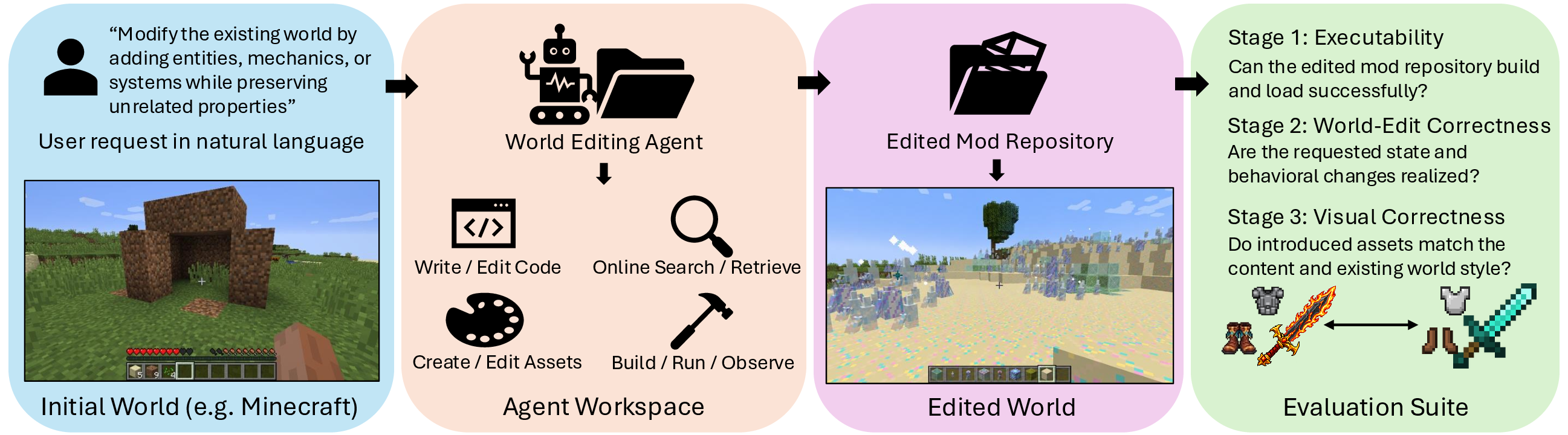
We formulate world editing as an intervention on an existing executable world. Let a world be abstractly represented as \(W = (S, T, R, \dots)\), where \(S\) denotes its entities and state space, \(T\) its transition dynamics, and \(R\) the rules and systems that govern interactions. Given a natural-language editing instruction, a world-editing agent transforms \(W\) as
IGMWorld and IGMBench
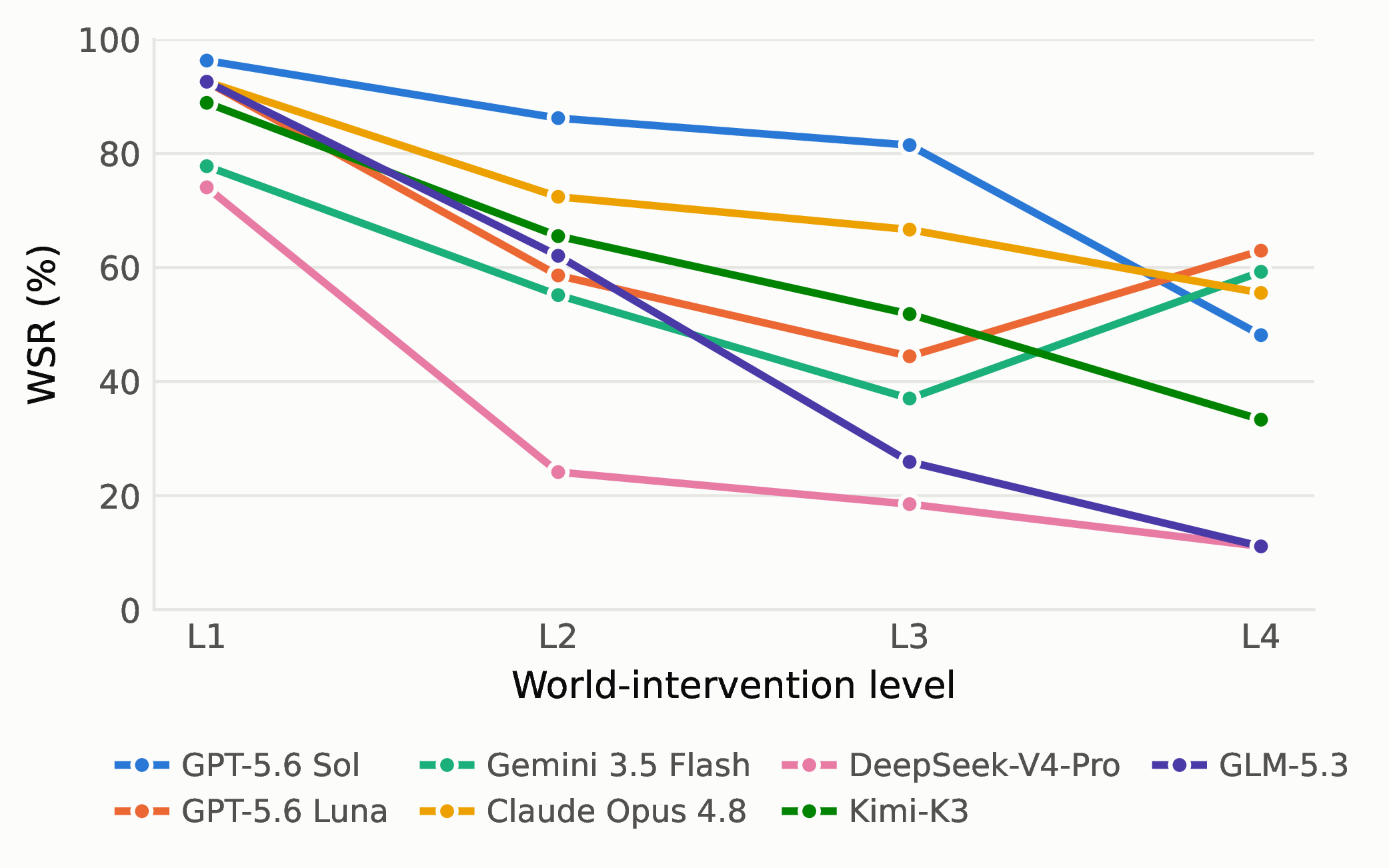
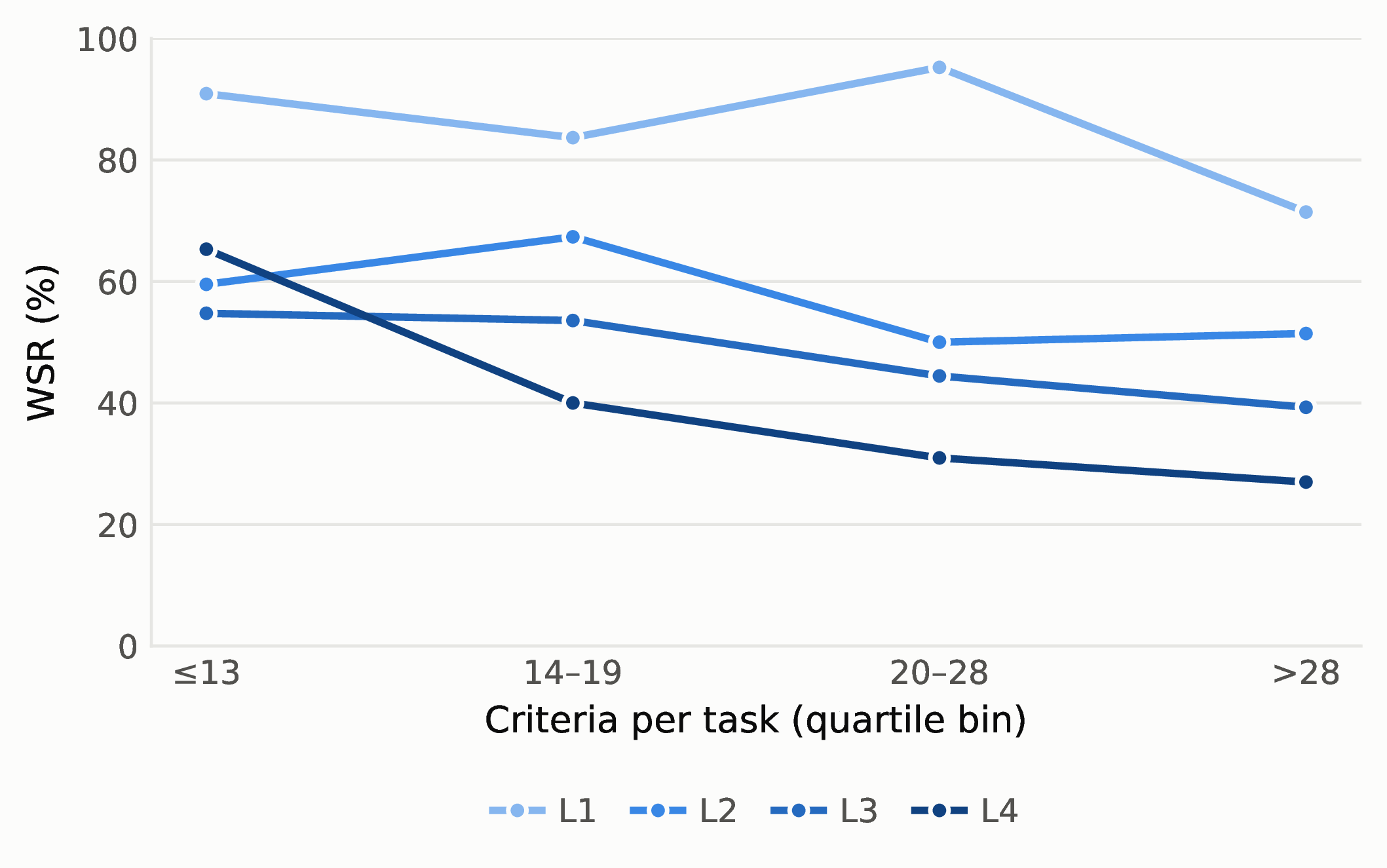
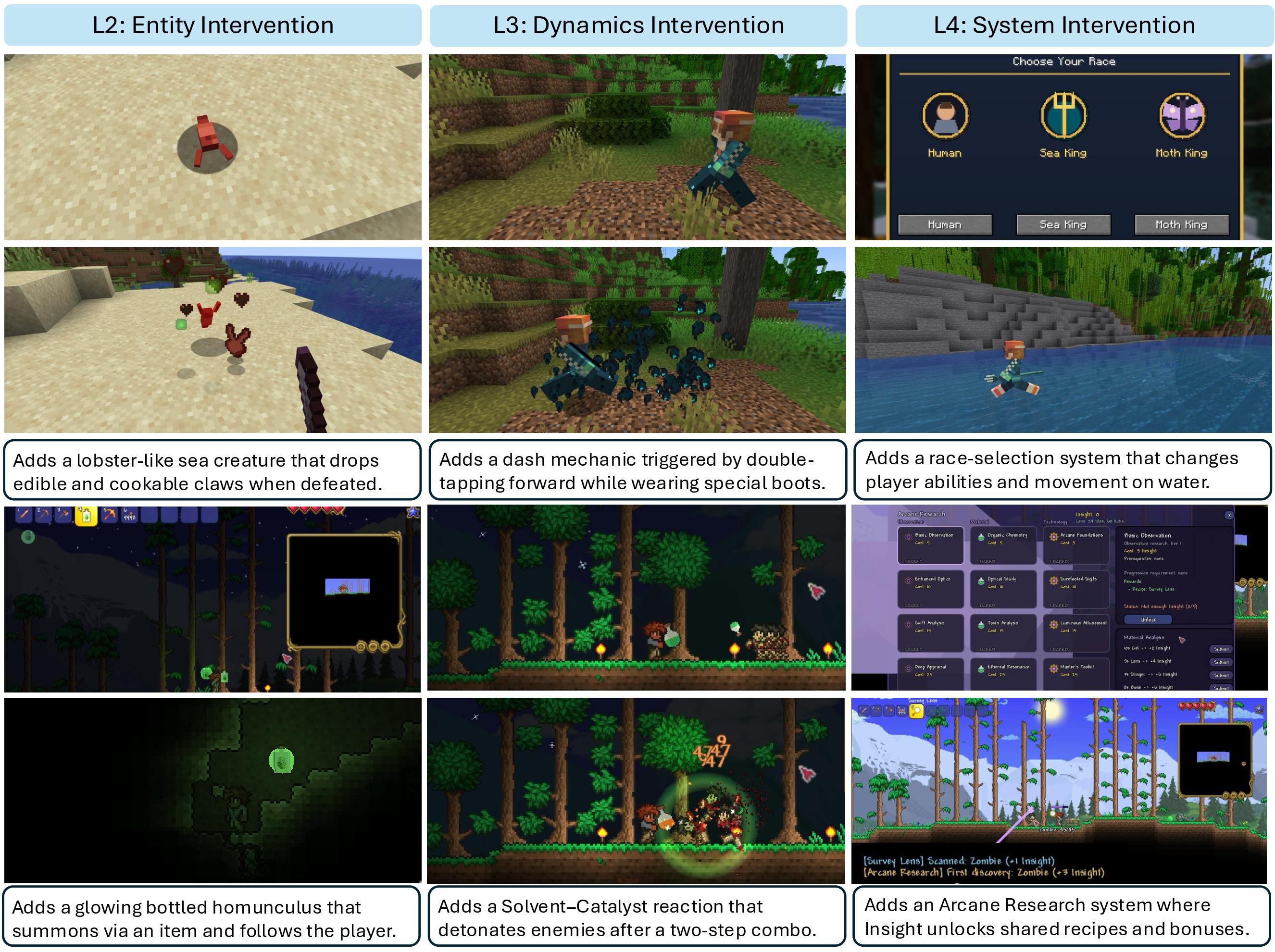
Two components support this evaluation. IGMWorld provides the executable environment in which agents modify existing game repositories, build and run their edits, and are evaluated on the resulting world rather than on code structure alone. IGMBench provides the task instances: 110 world-editing tasks across Minecraft and Terraria, distributed approximately evenly across the four intervention levels, with 1,161 state and behavioral criteria in total.