Signal and System Analysis [1] - Fundamentals
Mathematics Stuffs (Basic Concepts)
Calculations in rectangular form
Calculations in rectangular form
Addition/subtraction:
Multiplication:
Note .
Division:
Polar Form
Note p (magnitude) can only be postive.
materials support

examples
Conjugate
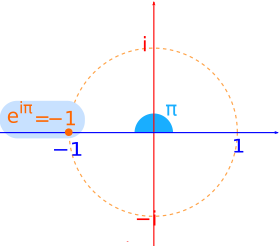
Euler’s Relation
Plotting
when we calculate Euler’s Formula for we get:
note here is acutally .
materials support
Now we know that :
| Exponential functions | equals to |
|---|---|
| 23.184 (note there are no … just normal calulcation.) |
Determine phase shift in a signal function (examples)
Steps:
- Draw the x(t) = 1and y(t) = 1 graph
- Sub = the number question required
- merge into the x(t) function and generate a new graph
- use the new graph to see whether the number match with
- The overlapping part is the
Sinusoids
A sinusoid is a signal that has its magnitude changes in time according to a sine function sin()
It is the basis of all signals.
sin() repeats itself for every 2 change in
Signal
-
- Amplitude
-
- Frequency
-
- Phase Shift
-
- Amplitude
-
- Frequency
Note:
Frequency where T = period.
Radian Frequency
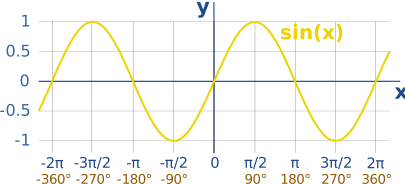
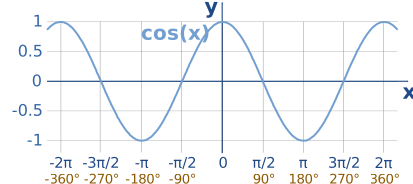
Cos Signal and Sin Signal
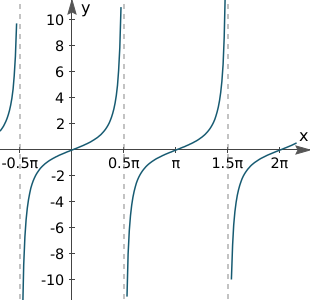
Tan Signal
Conversion of Signals
Note there is a 90 degree difference between sin and cos.
Transformations of Continuous-Time Signals
The rules same as graph transformation.

More About Transformations of Continuous-Time Signals
Lets say there is a continuous-time signal .
| Function | Transform |
|---|---|
| Translation by 2 units upwards | |
| Translation by 2 units downwards | |
| Translation by 2 units to Left Hand Side | |
| Translation by 2 units to Right Hand Side | |
| Reflection over x-axis | |
| Reflection over y-axis | |
| Vertial stretch by a factor of 2 (y axis become twice) | |
| Vertial compression by a factor of (y axis become half) | |
| Horizontal stretch by a factor of (x axis become twice) | |
| Horizontal compression by a factor of 2 (x axis become half) |
Note:
=
=
=
Therefore shrinking by a factor of 2, then translate to right by 1 unit.
How to determine the value of a,b and c so that by looking at the graph:
Note:
a = length of y axis
b = length of x axis
c = translation
Period of combined signals
The Period equals to the LCM of the period of the signals.
Radian
-
Standard unit of angular measure
-
Equal to the length of the arc of a unit circle
-
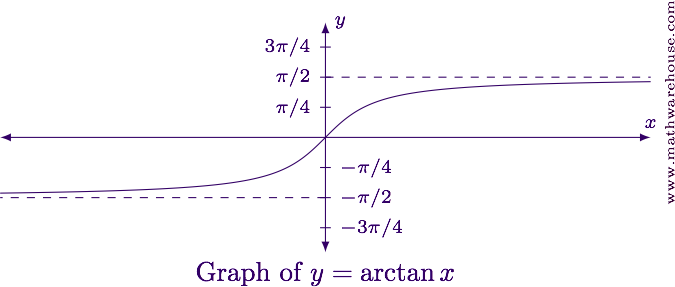
Some Special Trig function to remember:
Signal Representation (examples)
Partial Fraction
It is a trick for linear functions and quadratic functions.
Basically, find A,B,C,D… (the variables) to get the job done.
https://www.youtube.com/watch?v=oq8YZz7EqpU
Distinct Linear Factors
example :
You have this function
since
Multiply the whole thing with this , and you will get :
Now, find A and B. Make 1 side in the right become 0, and then another side.
let ,
Therefore .
Let ,
Therefore .
So the decomposition is :
Distinct Linear Factors with imaginary
Example :
You have this function
Multiply the whole thing with this , you will get :
note the form .
Looking at the imaginary part, ,
Looking at the real part,
Therefore